


Pharmaceutical & Biotech Industry Solutions

Flow Measurement Solutions That Meet GMP Standards

From purified water and WFI distribution to bioreactor gas control, API formulation, CIP/SIP validation, and clean utility metering — HBYB hygienic instruments are built for the documentation requirements, sterility standards, and process control precision that pharmaceutical and biotech manufacturing demands.
Discuss Your Application
Industry Segments We Support

Covering the Main Spectrum of Pharmaceutical & Biotech Operations

Each sub-sector presents distinct fluid measurement challenges — from sterile API production to large-scale biologic manufacturing. HBYB covers all of them from a single source.

Small-Molecule API & Drug Product

Synthesis reactor feeds, solvent metering, active ingredient transfer, formulation blending, and filling line flow control in regulated cGMP environments.
API synthesis
Solvent metering
Formulation blending
Filling lines

Biologics & Biotech

Upstream cell culture media, bioreactor gas supply, buffer preparation, downstream purification, and fill-finish operations under strict sterility requirements.
Cell culture media
Bioreactor gas
Buffer preparation
Fill-finish

Injectable & Sterile Products

Water for Injection (WFI) distribution loop metering, clean steam supply, aseptic fill line flow monitoring, and CIP/SIP validation on all product-contact circuits.
WFI distribution
Clean steam
Aseptic fill lines
CIP/SIP validation

Active Pharmaceutical Ingredients (APIs)

Fermentation-derived APIs, natural product extraction, solvent recovery metering, and chemical synthesis intermediates requiring documentation-complete flow measurement.
Fermentation API
Solvent recovery
Natural extract
Synthesis intermediate

Contract Development & Manufacturing

Multi-product facilities requiring rapid changeover, flexible metering across multiple batch types, and instrument documentation suitable for multiple regulatory submissions.
Multi-product lines
Batch flexibility
Regulatory documentation

Nutraceutical & Pharmaceutical-Grade

GMP-compliant supplements, veterinary pharmaceuticals, and pharmaceutical-grade ingredient manufacturing requiring hygienic instrumentation and full traceability documentation.
GMP supplement
Veterinary pharma
Ingredient metering
Full traceability
What Flow Measurement Covers

Three Fluid Systems With Fundamentally Different Measurement Requirements

Pharmaceutical facilities operate three distinct fluid systems simultaneously — each governed by different regulatory requirements, different sterility standards, and different measurement priorities.
GMP compliance shapes every flowmeter decision

In pharmaceutical manufacturing, flowmeter that lacks calibration certificates, material declarations, and GMP-compatible documentation cannot be used — regardless of its measurement performance.

Measurement Challenges

Five Conditions that define flowmeter selection in Pharma & Biotech

These are the selection criteria that distinguish a pharmaceutical-grade instrument decision from a standard industrial one.

GMP requirements apply to the instrument, not just the process

FDA 21 CFR Part 11 and EU GMP Annex 11 require that every measurement instrument in a GMP-regulated process has a calibration certificate, a material declaration (confirming wetted parts meet 21 CFR 177.2600 or equivalent), and an IQ/OQ/PQ qualification record. A meter without these documents cannot be installed in a regulated area, regardless of its technical performance. HBYB provides full material certificates, factory calibration documentation, and EN 10204 3.1 material declarations as standard on all hygienic-series instruments.
If overlooked:A non-documented instrument in a GMP area triggers a deviation report, requires retrospective qualification, and may invalidate batch records generated while it was in service.

WFI and purified water measurement has unique purity requirements

Water for Injection must maintain conductivity below 1.3 μS/cm at 25°C (EP/USP) and is measured in distribution loops at 70–80°C to prevent microbial growth. Standard electromagnetic flowmeters are compatible with WFI by principle — but their wetted materials (lining, electrodes) must be confirmed as non-leaching into an ultra-pure water matrix. Instruments with PTFE or PFA lining and platinum-iridium electrodes are the accepted configuration for WFI loop metering, where even ppb-level leaching is a product purity concern.
If overlooked: Metallic ion leaching from instrument wetted parts contaminates WFI below detectable thresholds until a batch quality test fails — at which point tracing the contamination source requires shutting down the entire distribution system.

Dead zones in instrument geometry are biofilm growth sites

Any cavity, crevice, port recess, or non-drainable pocket in an instrument wetted surface will trap product residue that resists CIP cleaning. In a sterile pharmaceutical environment, this residue becomes a biofilm nucleation site — invisible between cleaning cycles and detectable only through environmental monitoring swabs. Pharmaceutical-grade instruments must use smooth-bore construction, fully drainable sensor bodies, and sanitary tri-clamp connections that are completely swept during CIP. Dead zone elimination is a design criterion, not a performance specification.
If overlooked: Persistent biofilm in sensor dead zones triggers environmental monitoring failures that force a line shutdown and a root cause investigation before production can resume.

Mass-based measurement is required for high-value API solutions

Many drug product formulations require dosing active ingredients, excipients, or solvents to ±0.1% mass accuracy — not volumetric accuracy. Volumetric meters require a separate density input (from an inline densitometer or lab sample) to convert volume to mass, adding a second measurement uncertainty. Coriolis mass flowmeters eliminate this: they output mass flow directly, simultaneously measure liquid density, and require no density correction calculation — providing a single, audit-complete mass dose record for every batch event.
If overlooked: Volumetric dosing of density-varying API solutions produces systematic formulation errors that only become visible at final product assay — requiring batch rejection and a CAPA investigation.

Clean steam and pure steam aren't interchangeable measurement services

Conventional industrial steam and pharmaceutical clean steam or pure steam have different pressure, temperature, and condensate quality profiles. Pure steam (meeting EN 285 / HTM 2010) is used directly for SIP sterilization of product-contact surfaces at 121°C — and its flow measurement must use instruments with pharma-grade wetted materials, not standard industrial vortex meters. Sanitary vortex flowmeters with 316L SS body and tri-clamp connections measure both saturated and pure steam up to 350°C, compatible with the validation protocols required for SIP processes.
If overlooked: A standard industrial steam meter in a pure steam / SIP application uses non-food-contact materials that contaminate the sterilization circuit — invalidating the SIP cycle and requiring re-sterilization before aseptic production can begin.

Fluid Measurement Coverage Map

Where Measurement Occurs Across a Pharmaceutical & Biotech Facility

Every production stage and utility system requires flow measurement — each with different regulatory requirements and instrument specifications.
Stage 01
Water & Utilities
WFI / purified water
Clean steam
N₂ / compressed air
Sanitary Magnetic
Sanitary Vortex
Thermal Mass
Stage 02
Upstream Bioprocess
Media & buffers
Sparge gases
Nutrient feeds
Sanitary Magnetic
Sanitary Thermal Mass
Coriolis (low flow)
Stage 03
Downstream & Purification
Biologic harvest
Chromatography
UF/DF circuits
Coriolis (mass + density)
Sanitary Magnetic
Stage 04
Formulation & Filling
API & excipient dosing
Solvents
Aseptic fill
Coriolis (API mass)
Sanitary Turbine (solvents)
Sanitary Magnetic
Stage 05
CIP/SIP & Cleaning
CIP supply & return
Pure steam
Chemical dosing
Sanitary Magnetic
Sanitary Vortex (SIP)
Threaded Magnetic
Electromagnetic (Magnetic) Flowmeter
Vortex & Thermal Mass Flowmeter
Turbine Flowmeter
Coriolis Mass Flowmeter
Ultrasonic Flowmeter

Application-to-Instrument Guide

Find the Right Flowmeter for Your Process

Select the fluid category that matches your measurement task. Each card explains the selection rationale and links directly to the product specification page.
01 - WFI distribution loops

Water for Injection (WFI) loop metering at 70–80°C

WFI loops operate continuously at 70–80°C to prevent microbial growth. The meter must survive this thermal cycle, have zero dead zones in the wetted path, and use non-leaching materials compatible with the EP/USP purity limit of 1.3 μS/cm conductivity. Sanitary magnetic flowmeters with PTFE lining and platinum-iridium electrodes are the standard configuration for WFI loop metering.
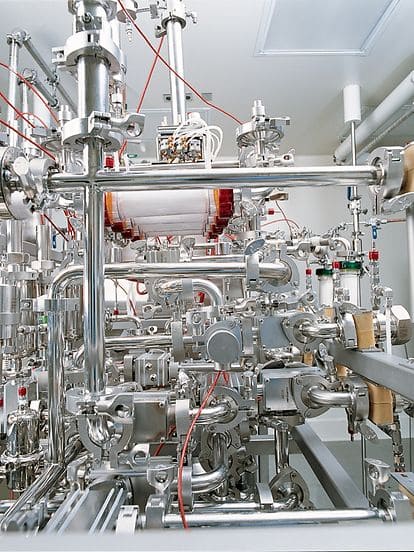

Best fit: WFI distribution loops, purified water ring mains, and ultrapure water supply to formulation and filling areas.
PTFE-lined, non-leaching
Pt-Ir electrodes
Tri-clamp / sanitary
Sanitary Magnetic Flowmeter →
02 - Purified water production & storage

Purified water make-up and tank replenishment

Purified water is consumed at varying rates across formulation, CIP, and utility services. Metering the production rate and tank replenishment volume provides the water balance data required for utility cost allocation and environmental reporting, without exposing the water stream to wetted materials that could affect purity specifications

Best fit: RO/EDI purified water production, storage tank filling, utility water distribution before point-of-use polishing.
316L SS wetted
Zero pressure drop
CIP/SIP compatible
Sanitary Magnetic Flowmeter →
03 - Large-bore utility water

Cooling water & plant water on large existing pipes

For existing large-diameter cooling water or plant water headers where pipe cutting is not permitted, clamp-on ultrasonic meters install externally with zero pipe penetration. No process interruption, no contamination risk, and no structural modification — making them the only viable option for adding metering to commissioned pharmaceutical building utility systems.

Best fit: Existing large-bore (DN200+) pipelines requiring sub-metering without shutdown.
Zero pipe penetration
No shutdown
Portable or permanent
Integrated Magnetic Flowmeter →
01 - Cell culture media & buffer preparation

Conductive aqueous media and buffer liquid metering

Cell culture media, buffer solutions, and nutrient feeds are conductive aqueous liquids — the ideal service for sanitary magnetic flowmeters. The critical requirement is zero dead zones and tri-clamp connections compatible with aseptic preparation vessel design. Measurement accuracy at the media preparation stage directly determines cell culture reproducibility across batches.

Best fit: Media preparation, buffer dilution, nutrient feed lines, and bioreactor liquid additions requiring CIP-compatible inline metering.
316L SS / PTFE wetted
Tri-clamp connection
CIP/SIP rated
Sanitary Magnetic Flowmeter →
02 - Bioreactor gas supply

Sparge gas metering to bioreactors and fermenters

Bioreactor dissolved oxygen and pH control depends on precise sparge gas delivery — oxygen, CO₂, and nitrogen each dosed at specific mass flow rates. Volumetric delivery varies with header pressure fluctuations, causing dissolved oxygen swings that affect cell viability. Inline thermal mass meters output kg/h or Nm³/h directly, ensuring consistent gas delivery regardless of supply pressure changes.

Best fit: Bioreactor and fermenter gas sparging lines for O₂, CO₂, N₂, and clean air. Small-bore, low-flow, high-precision.
Direct mass flow output
Pressure-independent
DN15–DN80
Sanitary Thermal Mass Flowmeter →
03 - Fermentation off-gas monitoring

CO₂ exhaust and off-gas flow from fermenters

Fermentation CO₂ off-gas flow is a real-time indicator of metabolic activity — rising when cells are growing, falling as carbon source depletes. Measuring off-gas volumetrically at the fermenter vent allows carbon balance calculation and early process deviation detection without sampling. Insertion thermal mass meters handle the low pressure, variable composition, and variable flow range of fermentation off-gas.

Best fit: Fermenter and bioreactor off-gas vents, CO₂ exhaust monitoring, carbon balance calculation in metabolic studies.
Low-pressure service
Wide flow range
No moving parts
Insertion Thermal Mass Flowmeter →
04 - Harvest & downstream purification

High-value biologic liquids — downstream processing

Downstream bioprocess streams — harvest broth, clarified supernatant, chromatography eluates, and concentrated biologics — have high value per liter and variable density as concentration changes during processing. Coriolis meters measure mass flow and fluid density simultaneously in a single instrument, providing the concentration-tracking data needed to confirm product titre at each process step without separate offline sampling.

Best fit: High-value biologic liquid streams where mass flow and inline density confirmation are needed simultaneously. Chromatography eluate, UF/DF circuits.
Mass + density
±0.1% accuracy
No straight-pipe required
Coriolis Mass Flowmeter →
05 - Nutrient feed & pH correction dosing

Low-flow nutrient and acid/base addition to bioreactors

Fed-batch bioreactor control requires continuous precise dosing of glucose feed, amino acid supplements, and pH correction agents (acid/base) at flow rates in the range of mL/min. At this scale, standard magnetic meters lack the sensitivity to detect small dosing deviations. Coriolis mass meters operating at low flow deliver the ±0.1% mass accuracy and the direct-mass output needed to verify that feed additions match the bioreactor control model exactly.

Best fit: Low-flow continuous nutrient feeds, pH correction dosing, and any small-volume liquid addition to bioreactors requiring mass-accurate documentation.
mL/min to L/hr range
Direct mass output
±0.1% accuracy
Coriolis Mass Flowmeter →
06 - Transfer between sterile vessels

Product-contact liquid transfer — vessel to vessel

Liquid transfers between hold tanks, bioreactors, and chromatography columns in sterile processing areas require fully enclosed, CIP/SIP-compatible flow measurement. The meter must not trap liquid between transfers — a dead zone in a sterile transfer line becomes a sterility risk for subsequent batches. Sanitary magnetic flowmeters with dead-zone-free design and tri-clamp connections are the standard choice for all sterile liquid transfer services.

Best fit: Sterile-area vessel-to-vessel transfers, bioreactor seed trains, buffer and media transfers in classified areas.
Dead-zone-free design
Sterile connection
CIP/SIP compatibility
Sanitary Magnetic Flowmeter →
01 - Active ingredient & excipient dosing

Precision mass dosing of API solutions and excipients

Drug product formulation requires dosing active ingredients and excipients to tight mass specifications — typically ±0.1–0.5% of target dose. Volumetric dosing introduces density-related errors when solution concentration changes slightly between batches. Coriolis meters output mass directly and simultaneously confirm solution density, providing a single audit record that covers both dose accuracy and concentration verification for each batch event.

Best fit: API solution dosing, excipient addition, concentrated ingredient metering where dose mass and solution density must be recorded.
Direct mass output
Inline density confirmation
±0.1% accuracy
Coriolis Mass Flowmeter →
02 - Solvent metering

Non-conductive pharmaceutical solvents and alcohols

Ethanol, isopropanol, acetone, and other pharmaceutical solvents are non-conductive — magnetic flowmeters produce no signal. These solvents are measured by turbine meters at ±0.5% accuracy with ±0.1% repeatability, providing the batch-to-batch consistency that solvent-based API synthesis and formulation requires. Explosion-proof certification is mandatory for all solvent-area instruments.

Best fit: Pharmaceutical-grade ethanol, IPA, acetone, and other clean, low-viscosity organic solvents in synthesis, extraction, and formulation.
±0.1% repeatability
Non-conductive liquids
Ex-proof certified
Sanitary Turbine Flowmeter →
03 - High-value liquid formulation

Precision batching of high-cost drug formulations

Injectable formulations, ophthalmic solutions, and biological drug products contain high-cost actives where a formulation error represents significant batch value loss. At batch values of $50,000–$500,000+, the cost of a Coriolis meter is trivial relative to the insurance value it provides through direct mass measurement, inline concentration verification, and an unambiguous electronic batch record for regulatory submission.

Best fit: Injectable formulations, high-value biologics, ophthalmic preparations, and any batch where product cost justifies the highest available measurement confidence.
Mass + density simultaneous
Electronic batch record
Regulatory submission ready
Coriolis Mass Flowmeter →
04 - Filling line & aseptic fill

Product flow to aseptic filling machines

Product liquid supply to aseptic filling machines requires continuous, clean-break-free flow measurement with no internal dead zones that could trap product between filling campaigns. The meter must be cleanable in place and must output a reliable flow signal for filling speed control. Sanitary magnetic flowmeters meet all these requirements for aqueous and conductive product formulations, with tri-clamp connections allowing sterile disconnection during machine changeover.

Best fit: Aqueous drug product supply to aseptic fillers, vial and ampoule filling line flow control, sterile product transfer in fill-finish areas.
Dead-zone-free flow path
Sterile tri-clamp connection
Filling speed control output
Sanitary Magnetic Flowmeter →
01 - CIP supply & return validation

CIP circuit flow confirmation for GMP batch records

GMP cleaning validation requires documented evidence that cleaning solution circulated at the designed velocity throughout every circuit. Timer-based records alone are insufficient — a partially closed valve or blocked circuit can pass a timed cycle while failing to achieve the required contact velocity. Flow measurement on CIP supply and return provides the velocity-confirmed cleaning record that FDA and EU GMP require as part of the cleaning validation protocol.

Best fit: CIP supply and return circuits on all product-contact equipment — bioreactors, mixing vessels, heat exchangers, and filling lines.
Velocity-confirmed cleaning
GMP batch record data
IP67 washdown rated
Sanitary Magnetic Flowmeter →
02 - SIP & pure steam sterilization

Pure steam flow during SIP sterilization cycles

SIP sterilization uses saturated pure steam at 121°C or higher to achieve a 10⁻⁶ sterility assurance level. Documenting steam flow rate throughout each SIP phase provides the process parameter record required to validate that sterilization conditions were achieved — and to demonstrate that any equipment failure during the cycle did not compromise sterility. The meter must use pharma-grade materials compatible with pure steam quality specifications.

Best fit: SIP circuits on aseptic production equipment, autoclave steam supply, and clean steam distribution in GMP areas.
316L SS body
Pure steam compatible
Up to 350°C
Sanitary Vortex Flowmeter →
03 - CIP chemical concentrate dosing

Caustic and acid concentration dosing to CIP make-up

CIP cleaning efficacy depends on achieving the correct cleaning solution concentration. Concentrated NaOH and HNO₃ are dosed volumetrically into the CIP make-up tank — but if the concentrate addition is not metered, over-dosing wastes chemical and risks equipment damage, while under-dosing produces a cleaning solution too dilute to remove biofilm. A small-bore threaded magnetic meter on the concentrate injection line provides direct confirmation of each chemical addition volume.

Best fit: CIP chemical concentrate addition — NaOH, HNO₃, peracetic acid — in small-bore dosing lines (DN15–DN40).
Small bore DN15–DN40
Chemical-resistant lining
Dose volume documentation
Threaded Magnetic Flowmeter→
014 - Utility steam to process heating

Industrial steam to jacket heating & indirect heat exchangers

Pharmaceutical processes use steam-heated jacket vessels and shell-and-tube exchangers for controlled temperature profiles in synthesis and formulation. Unlike pure steam for SIP, this utility steam does not contact the product — standard vortex meters with flanged connections are the appropriate and cost-effective choice for this service, measuring saturated and superheated steam up to 350°C with no moving parts and no maintenance schedule on the flow element.

Best fit: Utility steam supply to jacketed vessels, heat exchangers, and process heaters where steam does not contact the drug product.
Saturated & superheated steam
No moving parts
Up to 350°C service
Flanged Vortex Flowmeter →
01 - N₂ blanketing & inert overlay

Nitrogen supply for aseptic protection and inerting

Nitrogen blanketing on drug product hold tanks, sterile filtration circuits, and lyophilizer loading areas prevents oxygen ingress and maintains inert headspace. The N₂ supply must be metered by mass — not volume — to ensure consistent blanketing regardless of header pressure fluctuations. Sanitary thermal mass meters provide direct Nm³/h output with no separate transmitters, compatible with pharmaceutical gas systems.

Best fit: N₂ blanketing on drug product tanks, sterile-area inert atmosphere supply, lyophilizer loading and unloading nitrogen circuits.
Direct Nm³/h output
Pressure-independent
Tri-clamp sanitary
Sanitary Thermal Mass Flowmeter →
02 - Clean compressed air

Compressed air consumption monitorin & zone sub-metering

Clean and instrument-grade compressed air is consumed across pharmaceutical facilities for pneumatic actuators, packaging equipment, spray drying, and sterile area pressurization. Sub-metering by production zone identifies overconsumption, detects leaks in clean-area piping networks, and provides the cost allocation data needed for energy management reporting. Insertion thermal mass meters install on existing air headers without pipe cutting.

Best fit: Clean compressed air mains, instrument air distribution, sterile area pressurization supply — any existing header requiring added metering without process shutdown.
No pipe cutting
Direct mass flow
Leak detection capable
Insertion Thermal Mass Flowmeter →
03 - Spray drying & fluid bed gas

Drying air and process gas to spray dryers and fluid bed units

Spray dryers and fluid bed granulators consume large volumes of heated air or nitrogen at controlled mass flow rates that determine product particle size and moisture content. Varying inlet air mass flow produces product batches with inconsistent physical properties. Inline thermal mass meters on the dryer inlet provide the stable mass flow control that consistent drying performance requires, regardless of blower pressure variation.

Best fit: Spray dryer inlet air, fluid bed drying air, nitrogen drying circuits where mass flow stability directly controls product physical quality.
High-volume gas service
Direct mass flow control
DN25–DN200
Inline Thermal Mass Flowmeter →
04 - Cooling water circuits

Bioreactor jacket cooling and HVAC chilled water

Bioreactor temperature control depends on consistent cooling water flow through vessel jackets. Insufficient cooling water reduces heat removal capacity and causes temperature deviations that affect cell culture performance. Measuring cooling water flow on each bioreactor jacket circuit enables jacket performance monitoring and early detection of fouling — before it causes a temperature deviation that triggers a batch investigation.

Best fit: Bioreactor and vessel jacket cooling water, chiller distribution circuits, and HVAC cooling water sub-metering for energy management.
Conductive Liquids
Zero pressure drop
±0.5% accuracy
Integrated Magnetic Flowmeter →

Application Reference

CIP Validation & Bioreactor Gas Control at a Biologics Manufacturing Facility

These are the selection criteria that distinguish a pharmaceutical-grade instrument decision from a standard industrial one.

The Challenge

A China biologics manufacturer operating under FDA cGMP received an observation during inspection noting that CIP cleaning records were based on cycle time alone, with no flow-rate verification that cleaning solution had achieved design velocity in all equipment circuits. Concurrently, bioreactor dissolved oxygen control was inconsistent between batches — attributed to variable sparge gas delivery caused by supply pressure fluctuations that the volumetric rotameters in use could not compensate for.

The Solution

HBYB sanitary magnetic flowmeters (316L SS, PTFE-lined, tri-clamp, IP67) were installed on CIP supply and return circuits for all GMP equipment. Sanitary thermal mass flowmeters were installed on bioreactor O₂ and CO₂ sparge lines, providing direct Nm³/h output independent of header pressure. All meters output 4–20mA to the facility's DCS with batch record integration.

The Outcome

CIP velocity records generated from the first cleaning cycle provided the documented evidence required to close the FDA observation. Bioreactor dissolved oxygen control variance was reduced in the subsequent cell culture campaign, with sparge gas delivery now consistent regardless of facility air pressure fluctuations. GMP batch record completeness improved across all documented production runs.

316L

All wetted surfaces

IP67

Full washdown protection

4–20mA

DCS / batch record integration

FDA

Observation closed with flow data

GMP & Material Standards

Built to Meet Pharmaceutical Process Requirements

The documentation, materials, and design features that GMP quality systems require — provided as standard, not as options.

EN 10204 Material Certificates

Factory-issued material declarations for all wetted components — confirming 316L SS, PTFE, or PFA compliance with FDA 21 CFR 177.2600 and EU food/drug contact material regulations.

Dead-Zone-Free Hygienic Design

All sanitary-series instruments are engineered with smooth-bore flow paths, fully drainable sensor bodies, and tri-clamp connections that eliminate product trapping and biofilm nucleation sites.

CIP/SIP Validated Construction

Wetted materials and seals are rated for NaOH, HNO₃, peracetic acid, and saturated steam SIP cycles at 121°C — supporting multi-year CIP/SIP service without degradation or leaching.

Factory Calibration Documentation

Each instrument ships with a factory calibration certificate traceable to national standards, suitable for IQ/OQ documentation and as the baseline for periodic qualification requalification.

Request application support

Tell Us Your Process. We'll Specify the Right GMP-Compatible Instrument.

Whether you need a WFI loop meter, a bioreactor gas sensor, an SIP steam flowmeter, or a Coriolis for API dosing — describe your fluid, pipe size, and regulatory requirements. We provide a complete instrument specification with material certificates and calibration documentation within 24 hours.
Response within 24 hours from a technical specialist
If our flowmeter isn't the right fit for your application, we'll tell you so