Flow Measurement Solutions for Food & Beverage Industry
Accurate Flow Measurement Across Every Process in Your Facility
From raw ingredient intake to final packaging — whether you're measuring milk, syrup, steam, CO₂, or CIP cleaning circuits — HBYB helps food and beverage manufacturers match the right flowmeter to the real conditions of each process step.
Facilities balancing product lines, utilities, CIP systems, and wastewater with mixed measurement requirements
Industry Scope
What Flow Measurement Covers in Food & Beverage Industry
A single food or beverage plant operates multiple distinct fluid systems simultaneously — each with different requirements, different media properties, and different measurement priorities. No single meter type covers all of them.
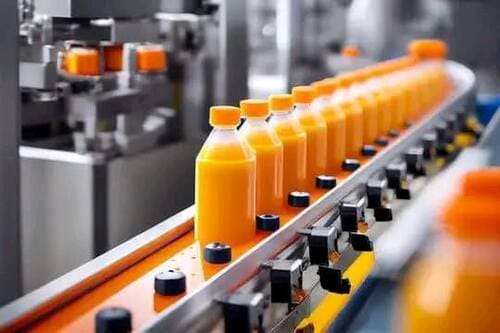
Product Process Fluids
Fluids that become or directly contact your product — measured for accurate batching, consistent formulation, and regulatory traceability at every production step.
Milk & dairy
Juice & beverage
Syrups & concentrates
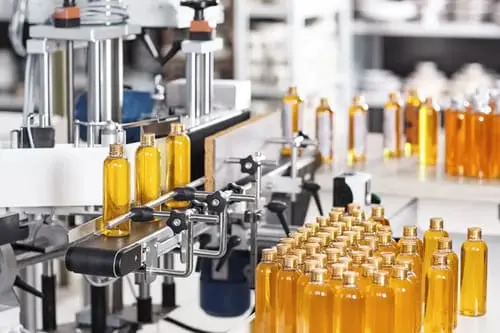
Edible oils
Sauces & condiments
Ethanol & spirits
Utilities & Process Support
The fluids and gases that enable production — measured for energy cost control, process stability, and consumption accountability across the facility.
Process water
Steam
Compressed air
CO₂ dosing
N₂ blanketing
Cooling water
Cleaning, Hygiene & Waste
The fluids used to clean and protect your production environment — measured to validate hygiene compliance and minimize environmental impact.
CIP supply & return
SIP steam
Caustic & acid circuits
Wastewater
Exhaust gas
Why flowmeter choice matters
The wrong flowmeter in a food process isn't just inaccurate — it becomes a hygiene risk, a compliance failure, or a source of invisible product loss.
Measurement Challenges
Six Conditions That Define Flowmeter Selection in Food & Beverage Industry
Each of these has a direct operational consequence when overlooked — not an abstract engineering concern.
Fluid conductivity — the primary technology gate
Milk, juice, water, beer, and sauces are water-based and conductive — magnetic flowmeters measure them with zero obstruction. Edible oils, ethanol, spirits, and pure syrups are non-conductive — magnetic meters produce no signal at all. A facility handling both fluid types requires two different meter technologies on the same production floor.
If overlooked: Installing a magnetic flowmeter on an edible oil line produces a zero reading or erratic output from the first day of operation — requiring a complete re-specification.
Viscosity variation across fluids
Process water runs at under 1 cP. Glucose syrup at 20°C can exceed 1,000 cP. High-fructose corn syrup reaches 5,000 cP. Vortex and turbine meters lose accuracy sharply as viscosity rises — their shedding frequency and rotor speed both respond poorly to thick fluids. Magnetic meters remain accurate regardless of viscosity. Coriolis meters measure directly by mass, making them viscosity-immune and ideal for high-value syrup dosing where density also matters.
If overlooked: urbine meters on high-viscosity lines systematically under-read at low flow, producing batching errors that compound with every production run.
Hygienic design — dead zones & cleanability
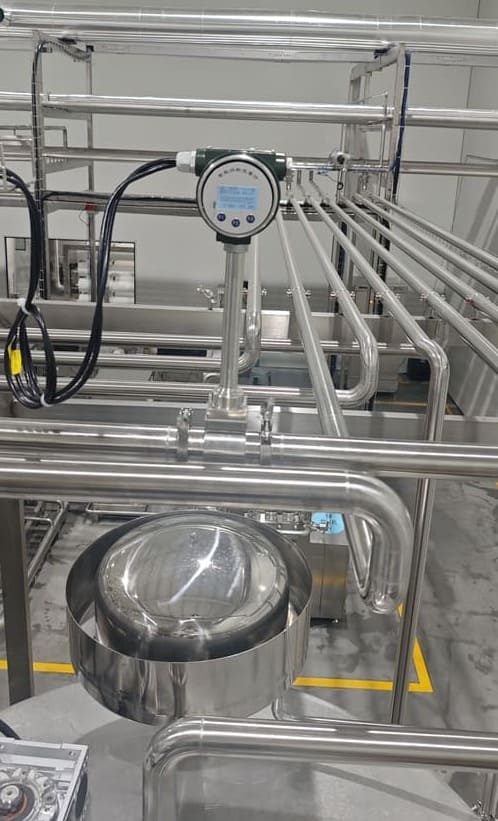
Flowmeter with internal crevices, gasket recesses, or non-drainable geometries trap product and resist CIP cleaning. HBYB hygienic-series meters use smooth-bore interiors, fully drainable sensor bodies, and tri-clamp connections designed to be completely swept by cleaning solution. The same principle applies to connection type: a threaded port in a sanitary line is a bacterial growth site that tri-clamp connections eliminate by design.
If overlooked: Biofilm formation in sensor dead zones triggers hygiene audit failures and forces unplanned production shutdowns for manual cleaning.
Repeatability vs. Accuracy — they aren't the same metric for batching
For ingredient dosing and batching, the critical metric is repeatability — — that each shot delivers exactly the same volume — not just average accuracy. A meter with ±0.5% accuracy but ±0.3% repeatability is worse for batching than a meter with ±1.0% accuracy and ±0.1% repeatability.. A turbine meter's high-frequency volumetric pulse output makes it the standard choice for batching non-conductive liquids (oils, ethanol). For the highest-value batching applications — concentrates, flavor extracts, pharmaceutical-grade ingredients — Coriolis mass meters offer both direct mass output and density measurement in one instrument, eliminating the need for separate density checks.
If overlooked: Batch-to-batch flavor or concentration variance that cannot be traced to a specific step — a quality failure that is expensive to investigate and impossible to prove without measurement records.
Gas measurement — mass flow, not volumetric
CO₂ for carbonation and N₂ for blanketing must be measured as mass flow (kg/h or Nm³/h), not volume — because gas volume changes with pressure and temperature while mass does not. Thermal mass flowmeters deliver direct mass output without any additional transmitters or flow computers. A volumetric meter on a CO₂ line will give different readings at the same actual mass flow depending on ambient temperature — an invisible source of carbonation inconsistency.
If overlooked: Carbonation level varies between production shifts as ambient temperature changes, with no instrument-based explanation for the inconsistency.
Steam service — temperature rules out most meter types
Pasteurization uses saturated steam at 130–145°C; UHT sterilization and SIP use superheated steam at up to 180°C. Turbine bearings fail under thermal shock. Differential pressure meters require impulse lines that are a maintenance burden in steam environments. Vortex meters — with no moving parts in the flow path — are the industry standard for food-grade steam measurement, operating reliably up to 350°C with no scheduled maintenance on the flow element.
If overlooked: A turbine meter in steam service fails within months, requiring replacement at production shutdown — a preventable cost with the correct meter selection.
A faster way to shortlist
How to Narrow the Right FLowmeter Without Overcomplicating the Decision
You do not need to become a flow measurement specialist to reach a strong first shortlist. In most food and beverage projects, four practical questions eliminate most unsuitable options immediately.
Question 01
Which fluid are you measuring?
Start with the medium: conductive liquids, viscous ingredient, non-conductive liquid, steam, gas, plant water, or wastewater. This is the fastest way to filter the meter family.
Question 02
Does the line require sanitary design?
If the pipeline is product-contact or part of a hygienic skid, sanitary construction, cleanability, and CIP / SIP compatibility matter as much as measurement accuracy.
Question 03
What is the measurement objective?
Transfer totalization, precise dosing, density-sensitive batching, steam/gas monitoring, water sub-metering, and wastewater reporting each point to a different best-fit solution.
Question 04
What is the installation reality?
Inline sanitary installation, retrofit without shutdown, large pipe utility service, partially filled drains, and open channels should never be treated as the same measurement problem.
Fluid Measurement Coverage Map
Find the Right Meter for Your Process
Select the fluid type that matches your measurement task. Each card explains the specific scenario, the measurement challenge, and the correct instrument recommendation — with a direct link to the product page.
Phase 01
Phase 02
Phase 03
Phase 04
Phase 05
Phase 06
Raw Material Liquids Transfer
Milk / juice
Edible oil
Process water
Sanitary Magnetic
Sanitary Turbine
Clamp-On Ultrasonic
Processing & Blending
Liquid ingredients
Syrups / concentrates
Ethanol / spirits
Sanitary Magnetic
Coriolis Mass
Sanitary Turbine
Sterilization & Pasteurization
Saturated steam
Superheated steam
Hot condensate
Sanitary Vortex
Multivariable Vortex
Magnetic (condensate)
Packaging & Filling Process
CO₂ dosing
N₂ blanketing
MAP gas mix
Sanitary Thermal Mass
Inline Thermal Mass
Sanitary Magnetic
CIP & SIP Cleaning Process
Caustic & acid
Rinse water
SIP steam
Sanitary Magnetic
Sanitary Vortex (SIP)
Threaded Magnetic
Wastewater & Waste Gas Treatment
Compressed air
Cooling water
Wastewater / biogas
Insertion Thermal Mass
Integrated Magnetic
Clamp-On Ultrasonic
Electromagnetic (Magnetic) Flowmeter
Vortex & Thermal Mass Flowmeter
Turbine Flowmeter
Coriolis Mass Flowmeter
Ultrasonic Flowmeter
Application-to-Instrument Guide
Find the Right Meter for Your Process
Select the fluid type that matches your measurement task. Each card explains the specific scenario, the measurement challenge, and the correct instrument recommendation — with a direct link to the product page.
Milk, Juice & Water
Oils, Spirits & Syrups
Steam & Sterilization
CO₂, N₂ & Gas Utilities
CIP & Cleaning
Plant Water & Waste
01 - DAIRY
Raw Milk Intake & Pasteurized Milk Transfer
Volumetric measurement at tanker unloading and throughout the pasteurized milk loop. Milk is conductive (≈500–1000 μS/cm); the tri-clamp meter must survive CIP caustic cycles at 80°C+ without calibration drift.
High-accuracy volumetric flow for fruit juice, process water, wort, soft drink base, and other conductive beverage streams. Zero pressure drop, no obstruction, no moving parts to foul.
Yogurt, whey, and cream are conductive with variable solids content. Magnetic meters with PTFE or PFA linings handle these streams without accuracy degradation, regardless of suspended solids. No moving parts to foul.
Tomato paste, soy sauce, vinegar, and similar products are moderately to highly conductive and may contain suspended solids. Magnetic meters measure regardless of solids content, with no obstruction elements to clog or wear.
For existing large-bore piping (DN300+) where full-bore installation requires cutting the line, clamp-on ultrasonic meters install on the outside of the pipe with no process shutdown and no pipe modifications — measuring conductive or non-conductive liquids equally.
Vegetable oils are non-conductive — magnetic flowmeters produce no signal. Sanitary turbine meters are the correct choice for clean, low-viscosity refined oils. The ±0.1% repeatability makes them ideal for dosing and filling control.
Ethanol and spirit distillates are non-conductive. Turbine meters with 316L stainless wetted parts and explosion-proof certification (ExiaIICT4) are the standard for ethanol metering in beverage distillation and blending operations.
For high-value liquid concentrates and flavor extracts where density measurement at the point of dosing confirms concentration — and where a second instrument trip is not acceptable — Coriolis meters provide simultaneous mass flow and density in one connection, enabling inline QC at every batch.
Glucose syrup and HFCS at ambient temperature exceed 1,000–5,000 cP — well above the turbine meter’s viscosity limit. Coriolis meters measure mass flow directly, immune to viscosity changes, making them the correct choice for high-viscosity syrup batching where accuracy cannot be compromised.
Blending multiple oil components requires repeatable batch dosing from each source tank. The ±0.1% shot-to-shot repeatability of sanitary turbine meters makes them the standard for batching non-conductive food-grade liquids in multi-component blending systems.
Tempered liquid chocolate and cocoa butter are non-conductive and temperature-sensitive. Coriolis meters handle both the non-conductive nature and the viscosity at working temperature (40–50°C), while providing density monitoring that confirms temper quality as a continuous measurement.
Saturated steam at 130–145°C supplies plate or tubular heat exchangers in HTST pasteurization. Vortex meters measure steam with no moving parts, no impulse lines, and no scheduled maintenance on the flow element — the correct technology for hygienic production zones.
UHT sterilization uses direct steam injection or heat exchange at 135–150°C; retort sterilization uses pressurized steam at similar temperatures. The multivariable vortex with integrated temperature and pressure compensation outputs mass flow directly, eliminating a separate flow computer.
SIP cycles use steam at 121–135°C to sterilize vessel internals in aseptic food production. The steam flow rate during SIP determines sterilization efficacy. Documenting steam flow at each SIP phase provides the process validation record required for food safety audits.
Central boiler steam distributed to multiple process points — pasteurization, CIP heating, building heat. Measuring at the header and at each branch enables energy accountability and production line cost allocation. The multivariable vortex delivers this as a single-instrument solution.
CIP chemicals are heated by hot water circuits at 70–90°C. Measuring hot water flow on CIP heating loops enables energy monitoring and validates that heating capacity matches the CIP design flow rate for each circuit.
Condensate return flow monitors heat exchanger efficiency and steam trap performance. Hot condensate is conductive water — magnetic flowmeters measure it precisely with no pressure drop, providing a direct efficiency indicator for the entire steam system.
Carbonation level is defined by mass of CO₂ dissolved per unit volume. A volumetric meter cannot control dosing if supply pressure fluctuates. A thermal mass meter delivers kg/h directly — enabling precise, pressure-independent carbonation control that delivers consistent product across all shifts.
Nitrogen blanketing protects oxygen-sensitive products — edible oils, wines, juices — from oxidation during tank storage and transfer. The N₂ mass flow rate determines blanket integrity. Thermal mass meters provide direct Nm³/h output with no pressure compensation required.
MAP lines inject a specific mix of CO₂ and N₂ into packaging to extend shelf life. Each gas component must be metered to the correct mass flow ratio — one thermal mass meter per line delivers this without a flow computer or manual compensation calculation.
Compressed air is the most widely used and most poorly monitored utility in food production. Insertion thermal mass meters on main air headers reveal consumption by zone, identify leaks, and support energy cost allocation — with no pipe cutting required on existing mains.
Brewery and winery fermentation generates CO₂ that can be captured and re-used for carbonation or MAP. Measuring off-gas at each fermenter quantifies recovery potential and tracks fermentation progress without disrupting the fermentation environment.
Boiler fuel gas consumption determines energy cost per production unit. A gas turbine meter with integrated temperature and pressure compensation delivers standard volume output (Nm³/h) directly for billing and energy reporting — without a separate flow computer.
The CIP supply line delivers caustic (NaOH), acid (HNO₃), and rinse water sequentially to each circuit. Measuring supply flow confirms the designed velocity is reached before the cycle timer starts — preventing an under-powered clean from being recorded as complete.
Return line flow rate confirms that cleaning solution is circulating through the entire circuit, not just the feed side. A low return flow indicates a blockage or incomplete circuit — invisible without measurement, and the most critical CIP data point for validating cleaning efficacy.
Final rinse water volume determines whether adequate dilution of cleaning chemicals has occurred before the line returns to production. A totalizing magnetic meter provides a documented volume count per CIP cycle — the basis for rinse validation records required by food safety auditors.
SIP steam flow rate and exposure duration together determine the sterilization log reduction achieved. Documenting steam flow at each SIP phase provides the process validation evidence required for aseptic and pharmaceutical-grade food production compliance records.
CIP chemicals are heated to 70–85°C before injection. Monitoring hot water consumption on CIP skids enables energy cost attribution per clean and flags heat exchanger fouling before it delays a cleaning cycle — a predictive maintenance signal available at no additional instrumentation cost.
Concentrated caustic and acid are dosed into the CIP make-up tank by a dosing pump. An inline magnetic meter on the concentrate line verifies the correct volume was added before dilution — preventing an under-strength or over-strength cleaning solution from being used in production circuits.
Water represents 3–10% of operating costs in food and beverage production. Sub-metering individual production zones identifies where reduction is feasible and creates the accountability data needed to meet water stewardship and sustainability targets.
Food and beverage facilities generate high-COD wastewater from product residuals, CIP drainage, and washdown. Measuring effluent volume at the drain header enables discharge charge calculation and environmental compliance reporting under permit conditions.
Floor drainage and open-channel wastewater from production washdown flows in partially-filled channels, not under pressure. Partially-filled magnetic flowmeters or open-channel ultrasonic meters measure this flow — a requirement for environmental discharge compliance in many regulatory jurisdictions.
Food processing wastewater treated via anaerobic digestion produces biogas (60–70% methane) for energy recovery. Insertion thermal mass meters measure biogas at low pressure on existing digester headers without pipe modifications or process shutdown.
Fermentation cooling jackets, pasteurizer cooling, refrigeration systems, and product chillers all use recirculating cooling water. Monitoring cooling water flow enables heat transfer efficiency calculation and early fouling detection — before it affects product temperature control.
For existing large-diameter water supply or cooling mains where process shutdown is not permitted, clamp-on ultrasonic meters mount on the exterior without cutting the pipe. Suitable for initial water audit surveys and permanent sub-metering on established infrastructure.
Tell Us What You Need to Measure — We’ll Help You Narrow the Right Solution
Share your process medium, connection standard, pipe size, operating conditions, and hygiene requirements. We’ll help you match the flowmeter model that best suits your specific application needs.
Response within 24 hours from a technical specialist, not a form letter
If a HBYB meter isn't the right fit for your application, we'll tell you so
Suitable for RFQ-stage evaluation, new project selection, replacement planning, and technical pre-screening before final specification.
Talk to a Flow Measurement Specialist
Share your application details with us, and we’ll help you find a reliable flowmeter solution for your operating conditions
Need Help Choosing the Right Flowmeter?
Share your operating conditions and measurement needs, and our team will help match you with the most suitable fluid measurement solution.
Get an Instant Quote
Submit your requirements and receive a professional quotation based on your process, media, and operating conditions.
This site uses cookies for analytics and to improve your experience. By clicking Accept, you consent to our use of cookies. Learn more in our privacy policy.