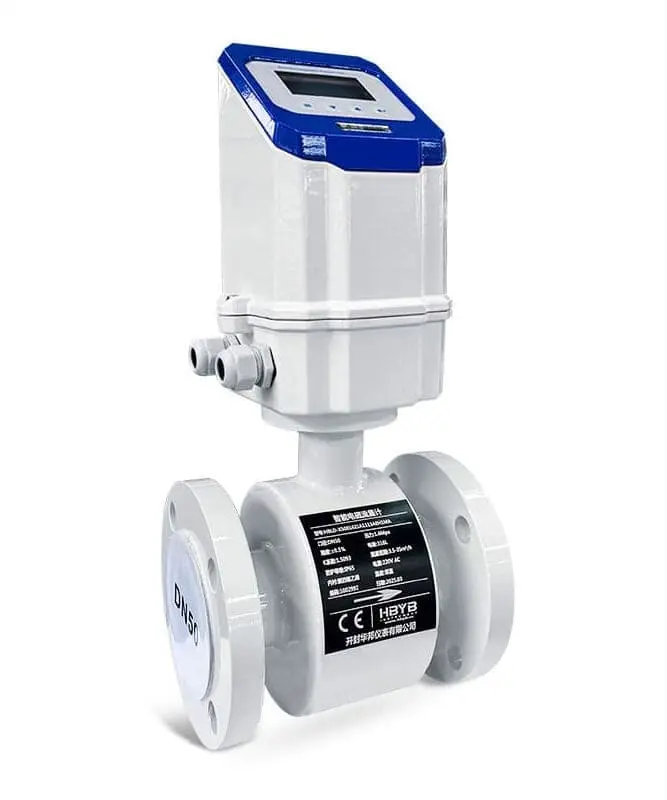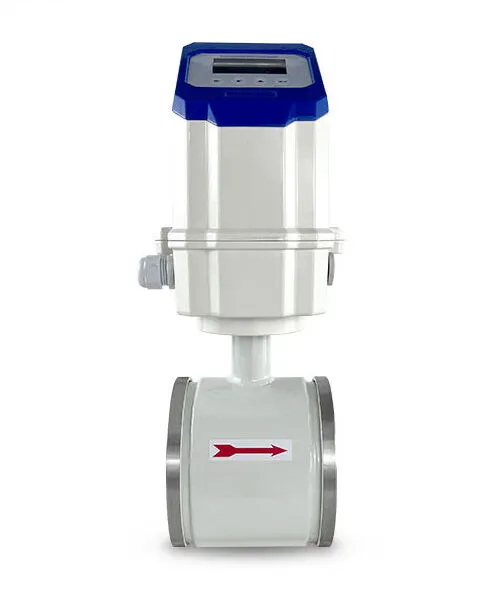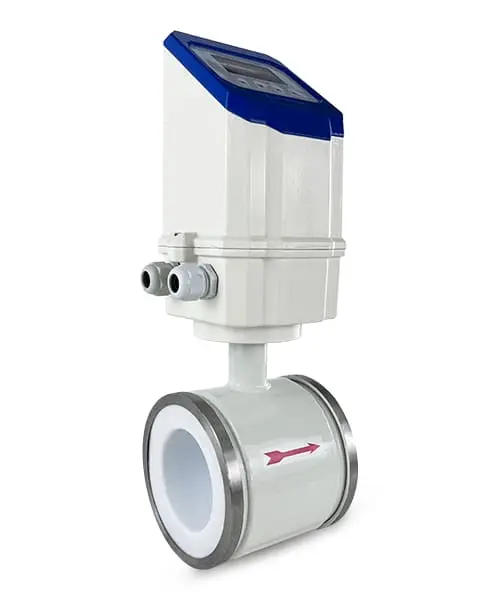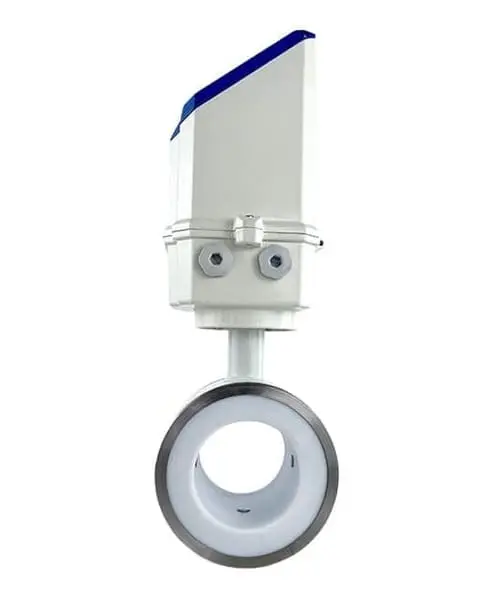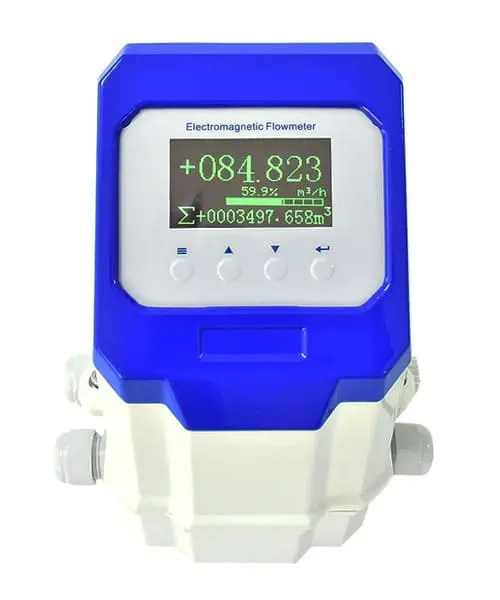

Integrated Electromagnetic Flowmeters

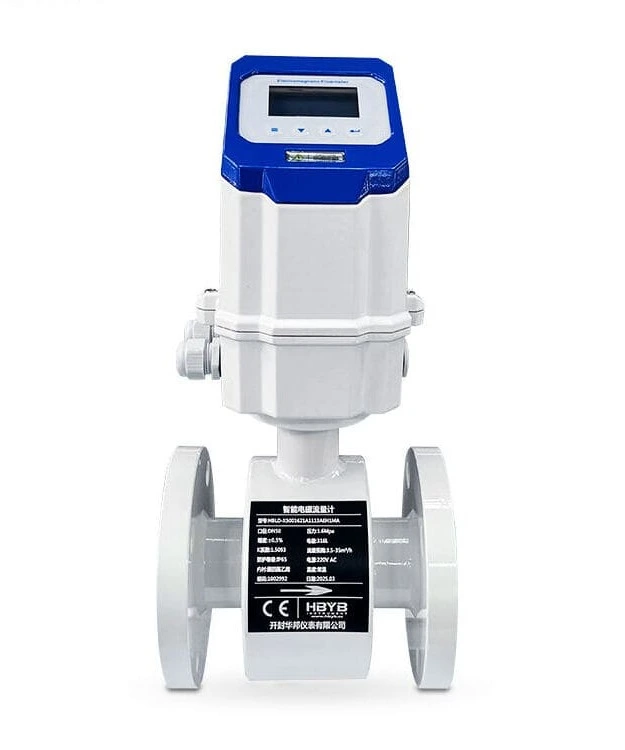
The HBLD-X is a high-performance electromagnetic flowmeter designed for the precise measurement of conductive liquids and slurries. With no moving parts and a customizable range of liners and electrodes, it provides a stable, long-term solution for even the most corrosive or abrasive industrial environments.
  • All-in-one compact design simplifies installation
  • Handles corrosive media, slurries, and challenging fluids
  • Individually calibrated for ±0.5% accuracy (±0.2% available)
  • 6 lining options and 7 electrode materials for extreme applications
Request QuotationTechnical Consultation

How Electromagnetic Flow Measurement Works

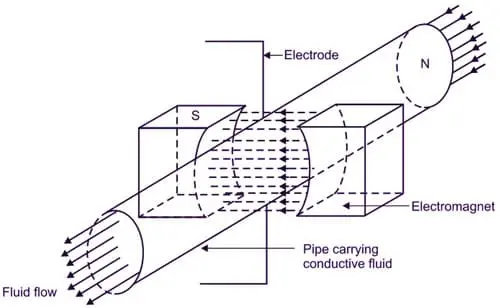
Electromagnetic flowmeters measure flow velocity by applying Faraday's Law of electromagnetic induction: The meter generates a magnetic field across the pipe. As conductive fluid flows through this field, a small voltage is created between two electrodes in the pipe wall. This voltage is directly proportional to the average velocity of the fluid. Since the pipe diameter is known and constant, velocity can be converted to volumetric flow rate.

What this means for your application:

The measurement is non-intrusive—nothing protrudes into the flow stream. The meter works regardless of fluid density, viscosity, or temperature (within rated limits). Because there are no moving parts and no obstruction, there's nothing to wear out, clog, or create pressure loss.

Is Electromagnetic Measurement Right for Your Application?

Before selecting the HBLD-X, verify your fluid meets one fundamental requirement: it must conduct electricity.
Suitable Fluids (Conductivity ≥5 μS/cm)
  • Water and wastewater (municipal, industrial, process)
  • Aqueous chemical solutions (acids, bases, salt solutions)
  • Slurries with conductive liquid phase (mining, pulp, mineral processing)
  • Food and beverage products (milk, juice, syrup, beer, wine)
  • Pharmaceutical solutions and cleaning fluids
Not Suitable (Non-conductive liquids)
  • Hydrocarbons: crude oil, gasoline, diesel, kerosene, fuel oils, lubricating oils
  • Pure organic solvents: pure alcohols, acetone, toluene, benzene, hexane
  • Liquefied gases: LPG, propane, butane, liquid nitrogen
  • Any gas or steam
  • Deionized or ultra-pure water (<5 μS/cm)
If the fluid conducts electricity—even weakly—electromagnetic measurement will work. If it's an electrical insulator, you need ultrasonic, Coriolis, or other technology. If uncertain about your fluid's conductivity, contact our application engineers for fluid compatibility verification.

Why Choose Electromagnetic Technology?

Handles challenging conditions other meters can't:

  • Measures slurries up to 30% solids content without clogging
  • Unaffected by viscosity, density, or temperature changes (within operating limits)
  • Bi-directional measurement without modification
  • Zero pressure drop eliminates energy loss in pumping systems
  • No moving parts means no mechanical wear or routine maintenance

Your process conditions favor electromagnetic measurement if you have:

  • Slurries or fluids with suspended solids that would clog mechanical meters
  • Corrosive chemicals requiring special wetted materials
  • Bi-directional flow that needs to be measured in both directions
  • Large pipe sizes where pressure drop would waste significant energy
  • Applications requiring long service life with minimal maintenance

Why Choose the HBLD-X Integrated Version?

Design advantage: Sensor and Converter Combined

Standard electromagnetic flowmeters use a two-piece design: a sensor on the pipe and a separate converter mounted elsewhere (control panel, junction box, or nearby wall). Our HBLD-X features an integrated construction where the signal converter is built directly into the sensor housing mounted directly on the pipe.

Practical advantages:

  • Reduced installation footprint—no separate converter mounting space required
  • Simplified wiring—single power connection instead of separate sensor and converter cables
  • Local display at point of measurement—operators can read flow without accessing control room
  • Lower installation labor—fewer cable runs and termination points
  • Suitable for field-mounted applications where local indication is needed

Environmental protection

Available in IP65, IP67, or IP68 ratings for outdoor installation, wet environments, or submersible applications up to 3 meters depth.

Power flexibility: Three power options accommodate different installation scenarios

220VAC for grid-powered locations, 24VDC for control system integration, or 3.6V lithium battery for remote sites without electrical infrastructure. Battery option provides 5-year operation without external power.

Measurement Advantages

The electromagnetic measurement principle offers several operational benefits compared to mechanical or differential pressure-based technologies:

High Accuracy

Standard ±0.5% accuracy with ±0.2% precision available for critical measurement points
Stable Accuracy

Accuracy unaffected by variations in density or viscosity

Wide Pressure Range

Standard ratings from 0.6 MPa to 10 MPa, custom high-pressure designs available to 42 MPa

Wide rangeability

100:1 turndown ratio allows accurate measurement across a broad flow range without meter replacement.

Temperature Resilient

Operates reliably from -25°C to +80°C across diverse industrial environments

No pressure loss

The measurement takes place through the pipe wall with no obstruction in the flow path, eliminating pumping energy losses.

Maintenance-free operation

No moving parts, bearings, or mechanical seals means no routine maintenance beyond periodic calibration verification.

Handles challenging fluids

Slurries, corrosives, and abrasive fluids that damage mechanical meters are measured reliably with appropriate liner and electrode material selection.

What You Need to Know

Accuracy depends on installation

The meter ships factory-calibrated, but measurement accuracy requires proper installation—adequate straight pipe, complete pipe fill, and correct grounding. See Installation tab for critical requirements.

Liner and electrode selection matters:

Different fluids require different materials. Corrosive chemicals need PTFE liner and exotic electrodes. Abrasive slurries need polyurethane liner. Water applications work fine with economical neoprene liner and stainless steel electrodes. See Technical Specifications tab for material selection guidance.

It's a proven technology

Electromagnetic flowmeters have been the industrial standard for conductive fluid measurement since the 1950s. The HBLD-X represents decades of refinement in a compact, reliable package backed by ISO 9001 manufacturing and factory calibration traceable to national standards.
Item
Specification
Model
HBLD-X
Measurement Principle
Electromagnetic induction (Faraday’s Law)
Accuracy Class
±0.5% of reading (Standard); ±0.2% or ±0.3% (Optional)
Pipe Diameter
DN10 – DN3000 (Custom sizes available for micro-flow)
Pressure Rating
  • Standard: 0.6, 1.0, 1.6, 2.5 MPa
  • High Pressure: up to 42 MPa (custom)
Applicable Media
Conductive liquids (min. conductivity ≥ 5μS/cm), slurries, pulps
Repeatability
±0.1% of reading
Flow Velocity Range
0.1 – 10 m/s
Damping Time Constant
0 – 100 seconds (adjustable)
Fluid Temperature
-25°C to +80°C
Ambient Temperature
-25°C to +60°C
Lining Material Options
Neoprene Rubber, PTFE, PFA, F46, Polyurethane, Silicon Fluoride
Electrode Material Options
316L Stainless Steel• Hastelloy B • Hastelloy C • Titanium • Tantalum • Platinum-Iridium • Tungsten Carbide
Flange Material Options
Carbon steel (standard), 304/316 stainless steel (optional)
Power Supply
  • AC: 85-250V, 45-63Hz
  • DC: 20-36V
Output Signals
4-20mA • Pulse/Frequency output • RS485 • Modbus protocol • HART protocol (optional) • Profibus DP (optional)
Display
  • LCD with backlight
  • Instantaneous flow rate (m³/h, L/min, GPM, etc.)
  • Cumulative total (forward/reverse/net)
  • Flow velocity (m/s
  • Alarm status
  • Diagnostic codes
Explosion-Proof
SIL-3 Certification
Quality Standards
CE Certification
Flange Standard
GB, ANSI, DIN, JIS (customizable)
Connection Type
Flange (standard), other types optional
Flange Material Options
Carbon steel (standard), 304/316 stainless steel (optional)

Lining & Electrode Selection Guide

Lining Material
Temperature Range
Characteristics & Applications
PTFE (F4)
-40°C to +130°C
Excellent chemical stability. Resists strong acids (Boiling Nitric, Aqua Regia) and alkalis.
PFA
-40°C to +180°C
Superior suction resistance for vacuum lines; high-temperature food and pharma applications.
F46 (FEP)
-40°C to +150°C
Similar to PTFE but with better abrasion resistance for medium-concentration slurries.
Neoprene Rubber
-20°C to +60°C
High elasticity and rupture strength. Ideal for low-cost water and sewage applications.
Polyurethane
-20°C to +60°C
Extreme abrasion resistance. Specifically for high-wear environments like coal slurry and mud.
Silicon Fluoride
-40 to +160°C
High-purity applications
Electrode Material
Corrosion Resistance
Typical Applications
SUS316L
General industrial fluids; resistant to organic acids and weak alkalis.
Municipal water, food processing, and non-corrosive chemical dosing.
Hastelloy B (HB)
Superior resistance to hydrochloric acid (HCl) and other reducing acids.
Specialized chemical plants with high HCl concentration environments.
Hastelloy C (HC)
High resistance to sulfuric acid, oxidizing acids, and oxidizing salts.
Mixed acid processing, chemical manufacturing, and complex waste streams.
Titanium (Ti)
Exceptional resistance to seawater, chlorides, and hypochlorite solutions.
Desalination plants, coastal water installations, and swimming pool systems.
Tantalum (Ta)
Extreme chemical resistance; nearly inert to all acids (except hydrofluoric acid).
Specialty pharmaceutical manufacturing and high-concentration hazardous chemicals.
Tungsten Carbide
Universal chemical resistance
Specialty pharmaceutical manufacturing and high-concentration hazardous chemicals.
Tantalum (Ta)
Non-corrosive, highly abrasive media
Specialty pharmaceutical manufacturing and high-concentration hazardous chemicals.

Protection Class

  • IP65: Dust-tight, protected against water jets—suitable for general indoor environments
  • IP67: Dust-tight, withstands temporary immersion—suitable for humid environments, short-term water exposure
  • IP68: Dust-tight, continuous submersion—suitable for underground pipelines, frequent water submersion, up to 3 meters depth

Built-in Diagnostic Capabilities:

The HBLD-X includes diagnostic functions that prevent measurement errors and reduce operating costs:
  • Empty pipe detection: Prevents false readings when pumps are off or pipes drain
  • Excitation alarm: Warns of sensor malfunction before total failure
  • Flow limit alarms: Configurable high/low flow warnings
  • Electrode status monitoring: Detects coating or contamination before accuracy degrades
  • Bi-directional measurement: Automatically identifies forward or reverse flow direction

Industry Application Guidance

The HBLD-X electromagnetic flowmeter is suitable for measuring conductive fluids across diverse industries. Below is general application guidance to help determine if electromagnetic measurement is appropriate for your specific fluid.

Important Note: The configurations listed below are general guidance for electromagnetic flowmeter technology, not documented installations of the HBLD-X specifically. For application-specific recommendations based on your exact fluid composition, temperature, pressure, and process conditions, please consult our application engineering team.


Water & Wastewater Treatment

Suitable Fluids:

  • Raw water, treated water, potable water
  • Process water, cooling water, boiler feedwater
  • Wastewater, sewage, effluent
  • Activated sludge, return activated sludge (RAS)
  • Waste activated sludge (WAS)
  • Digester feed, thickened sludge

Typical Liner Selection:

  • Clean water: Neoprene liner (cost-effective)
  • Sludge/high solids: Polyurethane liner (abrasion resistance) or Neoprene

Typical Electrode Selection:

  • General use: SUS316L stainless steel
  • High chlorine content: Titanium (if >100 ppm free chlorine)

Application Notes:

  • Empty pipe detection essential for applications with intermittent flow
  • IP68 rating recommended for outdoor or wet pit installations
  • Battery power option useful for remote monitoring stations

Chemical Processing

Suitable Fluids:

  • Sulfuric acid (H₂SO₄) at various concentrations
  • Hydrochloric acid (HCl)
  • Nitric acid (HNO₃)
  • Phosphoric acid (H₃PO₄)
  • Sodium hydroxide (caustic soda, NaOH)
  • Sodium hypochlorite (bleach, NaOCl)
  • Various salt solutions and brines

Typical Liner Selection:

  • Corrosive chemicals: PTFE, PFA, or F46 liner required
  • High temperature (>80°C): PTFE or PFA

Typical Electrode Selection:

  • Sulfuric acid: Hastelloy C
  • Hydrochloric acid: Hastelloy B or Hastelloy C
  • Sodium hydroxide: Hastelloy C or Nickel
  • Sodium hypochlorite: Titanium

Application Notes:

  • Verify liner and electrode compatibility with specific chemical and concentration
  • High-temperature applications may require special cable glands
  • Grounding critical in corrosive chemical service

Important: Contact application engineering before specifying for chemical service. Provide complete fluid data: chemical name, concentration, temperature, pH.


Mining & Mineral Processing

Suitable Fluids:

  • Iron ore slurry, copper concentrate slurry
  • Coal slurry, mineral slurries
  • Tailings, thickener underflow/overflow
  • Flotation circuit fluids
  • Process water with suspended solids

Typical Liner Selection:

  • Abrasive slurries: Polyurethane liner (best abrasion resistance)
  • Less abrasive: Neoprene liner acceptable

Typical Electrode Selection:

  • General mining slurries: SUS316L sufficient

Application Notes:

  • Size meter for lower velocity (<3 m/s) to extend liner life in abrasive service
  • Consider battery power for remote tailings lines without electrical infrastructure
  • Expect periodic liner replacement in high-abrasion applications (normal wear item)

Food & Beverage

Suitable Fluids:

  • Milk, cream, yogurt, whey
  • Fruit juices, concentrates, purees
  • Beverage syrups, soft drinks, beer, wine
  • Vegetable oils (if conductive additives present)
  • CIP (clean-in-place) solutions

Typical Liner Selection:

  • Food contact: PFA liner (FDA compliant)
  • General food processing: PTFE acceptable

Typical Electrode Selection:

  • Food grade: SUS316L stainless steel

Special Requirements:

  • Sanitary tri-clamp connections (available on request)
  • FDA 21 CFR 177.1550 compliant materials
  • 3-A sanitary standards (available on request)
  • Must withstand CIP cycles (hot caustic and acid cleaning)

Pharmaceutical & Biotechnology

Suitable Fluids:

  • Process water, purified water
  • Water for injection (WFI) – special low-conductivity model required
  • Pharmaceutical intermediates
  • Cleaning solutions (CIP/SIP)

Typical Liner Selection:

  • Pharma applications: PFA liner (cleanroom compatible)

Typical Electrode Selection:

  • General pharma: SUS316L
  • WFI (ultra-pure water): Tantalum with special signal booster

Special Requirements:

  • Sanitary design with tri-clamp connections
  • Electropolished wetted surfaces
  • FDA compliance and validation documentation
  • IQ/OQ protocol support available

Note: WFI measurement requires special low-conductivity circuit (conductivity <1.3 μS/cm). Standard HBLD-X not suitable without modification—consult engineering.


Pulp & Paper

Suitable Fluids:

  • White water, broke, stock flow
  • Black liquor (kraft process)
  • Bleach plant chemicals (sodium hypochlorite, chlorine dioxide)
  • Coating and sizing solutions

Typical Liner Selection:

  • Stock (fiber suspension): Neoprene or Polyurethane
  • Black liquor (high temp): PTFE required
  • Bleach chemicals: PTFE

Typical Electrode Selection:

  • General pulp stock: SUS316L
  • Black liquor: Hastelloy C
  • Bleach plant: Titanium

Application Notes:

  • Large pipe sizes common (DN200-DN600)
  • Empty pipe detection useful for batch processes
  • High-temperature cable glands needed for black liquor service

Power Generation

Suitable Fluids:

  • Cooling water circulation
  • Boiler feedwater (note: low conductivity)
  • Condensate return
  • Flue gas desulfurization (FGD) slurry

Typical Liner Selection:

  • Cooling water: Neoprene
  • FGD slurry: Polyurethane or PTFE

Typical Electrode Selection:

  • Cooling water: SUS316L
  • FGD (acidic slurry): Hastelloy C

Application Notes:

  • Boiler feedwater (demineralized) has very low conductivity—verify suitability
  • Large pipe sizes common in cooling water systems
  • 24/7 operation requires high reliability

Desalination & Marine

Suitable Fluids:

  • Seawater (intake and distribution)
  • Brine discharge
  • Brackish water

Typical Liner Selection:

  • Seawater: Neoprene liner adequate

Typical Electrode Selection:

  • Seawater/brine: Titanium required (high chloride corrosion resistance)

Application Notes:

  • IP68 submersible rating often required for seawater intake structures
  • Titanium electrode essential—SUS316L will corrode rapidly
  • Periodic electrode cleaning recommended (biofouling in seawater)

Fluid Compatibility Check

Before specifying HBLD-X, verify your fluid meets these basic criteria:

Electrically conductive (≥5 μS/cm minimum)

Liquid phase (not gas or steam)

Temperature within liner rating (Neoprene ≤80°C, PTFE ≤180°C)

Chemically compatible with liner (check chemical resistance chart)

Chemically compatible with electrode (check corrosion resistance data)

Not sure about compatibility? Submit fluid data for engineering review.

  • Maintenance-Free Solid State Design

    With no moving parts in the flow tube, the HBLD eliminates mechanical wear and potential leak points common in turbine or vortex meters.
  • Ultra-Wide Measurement Range

    Supports a flow velocity range from 0.1m/s to 15m/s, with a standard turndown ratio of 20:1 (up to 100:1 upon request).
  • Dual-Frequency Excitation

    Advanced square-wave excitation provides a stable zero point and high immunity to "slurry noise," making it ideal for pulp and mineral processing.
  • High-Speed Processing

    Equipped with a 16-bit embedded microprocessor, ensuring rapid response times and high-resolution output for batching applications.

  • Explosion-Proof Options

    With optional hot-tap insertion, you or your maintenance team can install or service the probe without stopping production.
  • Digital Signal Processing

    Drift and signal variability are significantly reduced thanks to its internal sensing and calibrated thermal technology, giving stable flow data over extended use.

Critical Installation Guidelines

Proper installation is essential for accurate, reliable measurement. Follow these proven best practices to avoid the most common errors.


1. Pipe Fill Requirement

✓ CORRECT:

  • Install at lowest point in piping system
  • Ensure pipe is 100% full at all times
  • Maintain adequate back-pressure downstream

✗ INCORRECT:

  • Installing at highest point (air accumulation)
  • Allowing partial pipe fill
  • Insufficient downstream pressure

Why it matters: Electromagnetic flowmeters require complete contact between fluid and electrodes. Partially filled pipes cause severe measurement errors.


2. Straight Pipe Requirements

✓ CORRECT:

  • Upstream: Minimum 5D straight pipe (10D preferred)
  • Downstream: Minimum 2D straight pipe

D = Nominal pipe diameter Example: DN200 meter needs 5 × 200mm = 1000mm upstream

✗ INCORRECT:

  • Installing directly after elbow (<2D)
  • T-junction immediately upstream
  • Pump discharge <5D upstream

Why it matters: Swirl and asymmetric flow profile cause measurement errors even with calibrated meter.


3. Flow Direction

Verify flow direction arrow on sensor body matches actual flow direction before installing.

The meter will indicate reverse flow if installed backwards (flow readings will be negative).


4. Grounding Requirements

For Metallic Pipes:

  • Connect meter body to pipe with grounding strap
  • Verify ground resistance <10Ω

For Non-Conductive Pipes (HDPE, PVC, FRP):

  • Install grounding rings upstream and downstream
  • Connect grounding rings to meter and earth ground

Why it matters: Without proper grounding, stray currents cause measurement instability and false readings.


5. Vibration & Support

✓ CORRECT:

  • Support piping independently upstream and downstream
  • Never use meter body as pipe support

✗ INCORRECT:

  • Flowmeter supports pipe weight
  • Rigidly mounted to vibrating pump

Why it matters: Mechanical stress causes sensor damage, flange leakage, and premature failure.


6. Electrical Installation

Power Supply:

  • 220VAC models: Use 3-core cable (L, N, Ground)
  • 24VDC models: Use 2-core shielded cable
  • Fuse: 2A maximum

Signal Output:

  • Use shielded cable for 4-20mA and RS485
  • Ground shield at converter end only (avoid ground loops)

Cable Entry:

  • Use proper cable glands matching IP rating
  • Install blanking plugs in unused cable entries

Contact Us

Email
info@hbmeter.cc
WhatsApp
(+86) 152-3780-0315
Address
1 Jingsan North Road, Xiangfu District, Kaifeng, Henan 475004 China

About HBmeter

AFT Instruments is a high-tech manufacturer delivering precision flow instrumentation for water, chemical, power, industrial automation, and process industries.
View more

Resources Download

Company and Product Information Download

Contact Us

info@hbmeter.cc
(+86) 152-3780-0315
(+86) 152-3780-0315

Related Products

Integrated Magnetic Flowmeter
Battery-Powered Magnetic Flowmeter
threaded Magnetic Flowmeter
Partial-filled pipe Magnetic Flowmeter
Slurry Magnetic Flowmeter
Scraper Electrode Magnetic Flowmeter