

Environmental & Emissions Monitoring Solutions

From industrial wastewater discharge metering and flue gas emission monitoring to biogas recovery, river flow gauging, and cooling water thermal discharge — HBYB instruments meet the documentation, certification, and measurement continuity requirements of environmental regulations worldwide.
Discuss Your Application
Industry Segments We Support

Covering the Mining & Mineral Processing

Environmental and emissions monitoring is not a single industry — it spans water quality compliance, air emissions reporting, renewable energy metering, surface water management, and industrial cooling. Each domain has its own regulatory framework and measurement requirements.

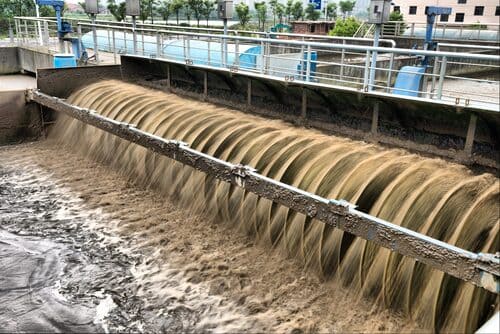
Industrial Wastewater & Effluent

Flow measurement at industrial discharge points, treatment plant inlet/outlet, and effluent polishing stages to document permit compliance and calculate discharge load.
Discharge permit metering
reatment plant flow
Chemical dosing
Gravity sewer & open channel

Flue Gas & Stack Emissions

Continuous stack flow measurement for power plants, incinerators, cement kilns, and industrial furnaces — the velocity input required by CEMS for pollutant mass emission rate reporting.
CEMS stack flow
Incinerator exhaust
Combustion air
Emission reporting

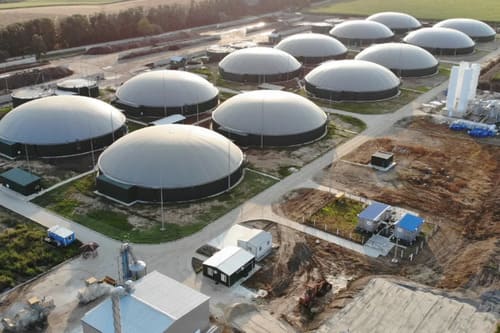
Biogas, Landfill Gas & Renewable Gas

Mass flow measurement for anaerobic digestion biogas, landfill gas capture, biomethane upgrading, and grid injection — from low-pressure collection headers to custody-grade biomethane billing.
Digester biogas
Biogas flare
andfill gas
Biomethane injection

Surface Water & Open Channel

River flow gauging, irrigation canal measurement, stormwater drainage monitoring, and water abstraction metering — primarily in open channels, weirs, and flumes where full-bore pipe metering cannot be applied.
River flow gauging
Irrigation & canals
Stormwater drainage

Cooling Water & Thermal Discharge

Intake and return flow metering for once-through and recirculating cooling water systems at power stations and industrial plants — required for thermal discharge permits and water use reporting.
Cooling intake metering
Thermal discharge
Water use reporting

Treatment Chemical Dosing

Precision metering of coagulants, disinfectants, pH adjustment chemicals, and nutrient removal reagents at water and wastewater treatment plants — where dosing accuracy directly determines treatment effectiveness and operating cost.
Coagulant dosing
pH adjustment
Disinfection chemicals
What Flow Measurement Covers

Each Requiring a Fundamentally Different flowmeter

Environmental monitoring instruments must simultaneously satisfy operational accuracy requirements and regulatory documentation requirements. The fluid category determines which measurement technology applies — and which regulatory standard governs the installation.

Environmental measurement is held to a higher standard

Regulatory agencies require that measurement instruments be verified, calibrated, and capable of generating legally defensible records. An flowmeter that merely measures is not sufficient — it must measure traceably.

Measurement Challenges

Five Conditions That Determine Instrument Selection in Environmental Monitoring

Each condition has a specific regulatory or operational consequence — not an abstract engineering concern.

Regulatory frameworks specify approved meter types and minimum accuracy

Environmental discharge permits and emissions licenses don't just require measurement — they frequently specify the approved measurement technology, minimum accuracy class, required data recording intervals, and mandatory calibration frequency. Installing an instrument not recognized by the applicable standard (e.g., EU IED, US EPA 40 CFR Part 75, ISO 4064) creates compliance records that may not be accepted by regulators, regardless of the instrument's actual measurement performance.
If overlooked: Discharge or emissions data collected with a non-compliant instrument may be rejected by regulatory authorities, exposing the operator to enforcement action even though measurement was performed.

Wastewater and open channel flows cannot be measured by standard pipe meters

Industrial drainage systems and natural watercourses frequently flow under gravity in partially-filled pipes, open channels, or with free-surface flow conditions. Standard electromagnetic, turbine, and vortex meters require a full pipe under pressure to function. Open channel flows require either a dedicated partially-filled pipe magnetic meter or an ultrasonic open-channel system that measures water level over a weir or flume and calculates flow from the hydraulic relationship.
If overlooked: Installing a full-bore pipe meter on a gravity drain produces wildly inaccurate readings or no reading at all — requiring a complete re-specification after installation.

Stack and biogas measurement demands extreme turndown and mass-based output

Flue gas flows during plant startup, normal operation, and peak load can vary 50:1 to 200:1. Landfill gas production changes with weather and seasonal conditions. Standard velocity meters (turbine, vortex) cannot cover this range at all. Mass flow — not volumetric flow — is the required output for emissions mass balance calculations under most regulatory frameworks. Only thermal mass insertion meters combine the required wide turndown, mass-based output, and large-diameter capability for these applications.
If overlooked: A turbine or vortex meter on a flue gas duct reads zero during startup and pegs at its maximum range during high-load — providing no usable data for exactly the periods that regulators examine most closely.

Remote sites require battery power and wireless data transmission

River gauging stations, stormwater monitoring points, and agricultural drainage outfalls are frequently located in areas without mains power or wired communication. Instruments must operate for 12–24 months on battery power, log flow data internally with timestamped records, and transmit via GPRS, Modbus, or RS485 to a central data management system. Battery-powered electromagnetic meters with GPRS telemetry are the standard instrument for remote environmental flow monitoring stations.
If overlooked: A mains-powered meter at a remote monitoring point becomes a data gap every time the power supply fails — and data gaps in environmental compliance records typically must be reported to the regulator.

Large-diameter infrastructure cannot be shut down for meter installation

Cooling water intake pipes, stormwater trunk sewers, and river abstraction headers are typically large-diameter (DN600–DN3000) and may carry flows that cannot be interrupted for full-bore meter installation. Insertion electromagnetic meters (hot-tap installation through a ball valve fitting) and clamp-on ultrasonic meters (exterior-mounted, no pipe penetration) provide the measurement capability of full-bore meters on large existing infrastructure — without any process interruption, pipeline cutting, or system modification.
If overlooked: Specifying a full-bore flanged meter for a large cooling water main requires shutting down the cooling system to install — a constraint that may be operationally impossible for a continuously operating power station or industrial plant.

Find the Right Meter for Your Application

What Are You Measuring? Start Here

Select the environmental monitoring category that matches your measurement requirement. Each card states the measurement challenge clearly, explains why the recommended instrument is the correct choice, and links to the product page.
01 - River gauging & abstraction metering

Flow measurement in rivers, irrigation channels, and water abstraction points for resource management and licensing compliance

Rivers, canals, and large irrigation channels have free-surface flow — no pipe, no pressure, and a water level that changes continuously with season and rainfall. Standard pipe-based meters cannot be used. Ultrasonic open-channel flowmeters measure water level over a calibrated flume or weir using non-contact ultrasonic level measurement and calculate flow from the hydraulic relationship between level and discharge. They install permanently above the water surface, require no submerged components, and produce continuous flow records suitable for water abstraction license reporting and environmental flow assessments.
Best fit: Rivers, irrigation canals, water abstraction weirs and flumes. Free-surface flow where no pipe exists. Non-contact measurement from above the waterline.
Non-contact
Continuous flow records
Works with any weir or flume type
Ultrasonic Open Channel Flowmeter
02 - Wastewater treatment & stormwater channels

Flow measurement in open-channel flumes and rectangular weirs at wastewater treatment works and stormwater drainage systems

Wastewater treatment plants and municipal stormwater systems use open channels, Parshall flumes, and V-notch weirs internally for process flow measurement — applications where the fluid is conductive wastewater but the flow is free-surface rather than pressurized. Magnetic open-channel flowmeters combine an electromagnetic velocity sensor submerged in the flow with a level sensor, measuring both velocity and depth to calculate actual discharge. They are widely accepted for regulatory flow measurement under standards such as ISO 4359 (open channel measurement using weirs and flumes).

Best fit: Wastewater treatment plant channels and flumes, stormwater drainage, regulatory open-channel measurement stations where the fluid is conductive.
Velocity + depth combined
Handles wastewater solids
Magnetic Open Channel Flowmeter
03 - Remote & unmanned gauge stations

Automated flow gauging at remote river monitoring stations, tributary gauges, and irrigation abstraction points without mains power

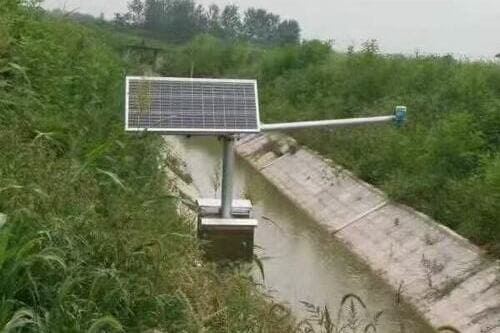
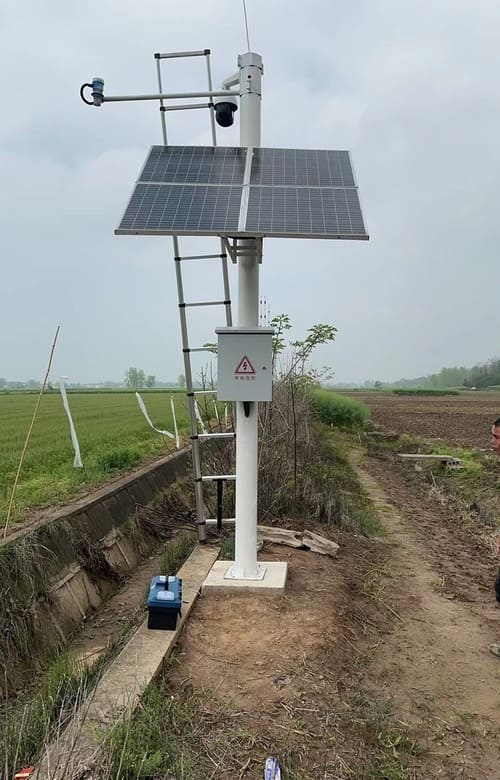
River flow monitoring networks and irrigation management systems require gauging stations at numerous remote locations — bridges, weirs, culvert outlets — where mains power is unavailable and site visits are infrequent. Battery or solar-powered ultrasonic open-channel flow loggers record water level and calculate discharge continuously, store 12+ months of timestamped data internally, and transmit readings to a central data platform via GPRS or LoRa. They provide the unbroken continuous flow record that water resource management, flood early warning, and irrigation permit compliance require.

Best fit: Remote river gauging stations, unmanned weir monitoring, irrigation scheme abstraction points. Locations without power or communication infrastructure.
Battery / solar powered
12+ months data storage
No submerged components
Ultrasonic Open Channel Flowmeter
01 - Power plant & industrial stack CEMS

Continuous stack gas flow measurement as the velocity input for CEMS pollutant mass emission rate calculations

CEMS (Continuous Emissions Monitoring Systems) calculate pollutant mass emission rates by multiplying gas concentration (from analyzers) by volumetric flow rate. The flow measurement component must cover the extreme 50:1 to 200:1 turndown caused by load changes, handle hot dust-laden flue gas at 150–400°C, and mount on large-diameter ducts (DN500–DN3000) without full-bore installation. Insertion thermal mass meters address all of this: hot-tap insertion through a single penetration, direct mass flow output in kg/h, turndown exceeding 200:1, and operating temperature up to 350°C.

Best fit: Power station, cement kiln, incinerator, and industrial furnace stacks. Large duct diameters, wide flow range, hot dusty gas service.
Up to 350°C gas temperature
200:1 turndown
Single hot-tap insertion
Insertion Thermal Mass Flowmeter
02 - Combustion air metering

Combustion air flow to boilers, kilns, and fired heaters for combustion efficiency and excess air monitoring

Combustion air metering provides the flow basis for combustion efficiency calculations and excess air control — a direct contributor to both energy efficiency and NOx emission rate. The measurement point is typically at the forced draft fan outlet or air duct leading to burner manifolds: clean, dry air at near-ambient temperature in pipes sized DN100–DN500. Inline thermal mass meters measure air mass flow directly without pressure or temperature compensation, connecting directly to the burner management system for closed-loop combustion air control.

Best fit: Combustion air ducting to industrial boilers, process furnaces, and burner installations. Clean dry air, DN25–DN200 pipe sizes.
Direct mass flow — no compensation
Clean dry air service
Closed-loop combustion control
Inline Thermal Mass Flowmeter
03 - Small source & diffuse emissions

Emission monitoring on small industrial sources, vent stacks, and process exhausts below the threshold requiring full CEMS

Many industrial sources — food processing dryers, paint shop exhaust, pharmaceutical solvent recovery vents — require flow measurement for emissions estimation but do not need the full capital cost of a CEMS installation. For small ducts (DN25–DN200), inline thermal mass meters provide continuous, calibrated gas mass flow measurement at low installed cost. For slightly larger ducts where inline installation is not practical, insertion thermal mass meters insert through a single 1-inch tap with no duct modification beyond a drilled hole and a weld-on fitting.

Best fit: Small industrial vent stacks and process exhausts (DN25–DN300) requiring continuous flow data for emissions estimation without full CEMS investment.
Low installed cost
Direct kg/h or Nm³/h output
Single-point installation
Inline Thermal Mass Flowmeter
01 - Digester biogas measurement

Biogas flow from anaerobic digesters at sewage treatment plants, food waste facilities, and agricultural digesters

Anaerobic digester biogas is produced at low pressure (10–30 mbar above atmospheric), with highly variable flow rate depending on feedstock loading and temperature, and with water vapor saturation that rules out most conventional gas meters. Insertion thermal mass meters handle all of these conditions: they operate at very low gas velocities, measure regardless of humidity, and their hot-tap installation avoids any disruption to the digester’s low-pressure gas containment. They output direct mass flow (kg/h) for gas production accounting and energy yield calculations required under renewable energy incentive schemes.

Best fit: Anaerobic digesters at sewage works, food waste and agricultural biogas plants. Low-pressure, wet biogas, variable production rate, DN100–DN1000 collection headers.
Operates at very low gas velocities
Humidity-tolerant measurement
Direct mass flow output
Insertion Thermal Mass Flowmeter
02 - Landfill gas capture & flare control

Gas collection from landfill wells, lateral headers, and flare station metering for greenhouse gas accounting and energy recovery

Landfill gas collection involves a network of extraction wells connected to lateral headers, each operating at slightly sub-atmospheric pressure with highly variable flow and methane content. Insertion thermal mass meters installed on the main collection header measure total gas production for greenhouse gas reporting (methane being a potent GHG requiring accurate quantification under carbon accounting protocols). For flare stations, a dedicated insertion meter on the flare inlet provides the continuous mass flow record required to demonstrate flare destruction efficiency — a regulatory requirement in most jurisdictions.

Best fit: Landfill gas main collection headers, flare station inlet metering, gas-to-energy plant feed metering. Variable composition, low pressure, large DN headers.
GHG accounting compliance
Flare destruction efficiency record
Variable composition tolerance
Insertion Thermal Mass Flowmeter
03 - Biomethane grid injection & sales metering

Custody-grade metering for upgraded biomethane delivered into the natural gas grid or sold under renewable energy contracts

Upgraded biomethane injected into the natural gas grid or sold under green gas contracts must be metered to fiscal custody transfer standards — the same standards applied to natural gas sales. The measurement must produce standard volume (Nm³) corrected for temperature and pressure, with Class 5 (±0.5%) or better accuracy, calibration traceability, and audit-ready data records. Gas turbine meters with integrated temperature and pressure compensation deliver this requirement in a single instrument, and are one of the accepted meter types under most gas grid injection standards (e.g., EN ISO 17089, AGA-7).

Best fit: Biomethane upgrading plant outlet metering, grid injection billing points, green gas contract measurement. Clean dry methane-rich gas, DN25–DN200.
±0.5% accuracy
Integrated T&P compensation
alibration traceable records
Direct Nm³/h output
Gas Turbine Flowmeter
01 - River gauging & abstraction metering

Flow measurement in rivers, irrigation channels, and water abstraction points for resource management and licensing compliance

Rivers, canals, and large irrigation channels have free-surface flow — no pipe, no pressure, and a water level that changes continuously with season and rainfall. Standard pipe-based meters cannot be used. Ultrasonic open-channel flowmeters measure water level over a calibrated flume or weir using non-contact ultrasonic level measurement and calculate flow from the hydraulic relationship between level and discharge. They install permanently above the water surface, require no submerged components, and produce continuous flow records suitable for water abstraction license reporting and environmental flow assessments.

Best fit: Rivers, irrigation canals, water abstraction weirs and flumes. Free-surface flow where no pipe exists. Non-contact measurement from above the waterline.
Non-contact — no submersion
Works with any weir or flume type
Continuous flow records
Ultrasonic Open Channel Flowmeter
02 - Wastewater treatment & stormwater channels

Flow measurement in open-channel flumes and rectangular weirs at wastewater treatment works and stormwater drainage systems

Wastewater treatment plants and municipal stormwater systems use open channels, Parshall flumes, and V-notch weirs internally for process flow measurement — applications where the fluid is conductive wastewater but the flow is free-surface rather than pressurized. Magnetic open-channel flowmeters combine an electromagnetic velocity sensor submerged in the flow with a level sensor, measuring both velocity and depth to calculate actual discharge. They are widely accepted for regulatory flow measurement under standards such as ISO 4359 (open channel measurement using weirs and flumes).

Best fit: Wastewater treatment plant channels and flumes, stormwater drainage, regulatory open-channel measurement stations where the fluid is conductive.
Velocity + depth combined
ISO 4359 compliant application
Handles wastewater solids
Magnetic Open Channel Flowmeter
03 - Remote & unmanned gauge stations

Automated flow gauging at remote river monitoring stations, tributary gauges, and irrigation abstraction points without mains power

River flow monitoring networks and irrigation management systems require gauging stations at numerous remote locations — bridges, weirs, culvert outlets — where mains power is unavailable and site visits are infrequent. Battery or solar-powered ultrasonic open-channel flow loggers record water level and calculate discharge continuously, store 12+ months of timestamped data internally, and transmit readings to a central data platform via GPRS or LoRa. They provide the unbroken continuous flow record that water resource management, flood early warning, and irrigation permit compliance require.

Best fit: Remote river gauging stations, unmanned weir monitoring, irrigation scheme abstraction points. Locations without power or communication infrastructure.
Battery / solar powered
12+ months data storage
No submerged components
Ultrasonic Open Channel Flowmeter Battery-Powered Magnetic Flowmeter
01 - Power station cooling water metering

Intake and discharge flow measurement on large-diameter cooling water systems at power stations and large industrial plants

Cooling water intake and return metering at power stations involves very large pipe diameters (DN600–DN3000), continuous non-stop operation, and regulatory requirements to report abstracted water volumes and thermal discharge temperatures under water use licenses. Full-bore flanged electromagnetic meters in these sizes are available but costly and require significant installation civil works. Insertion electromagnetic meters — installed through a hot-tap ball valve fitting — provide equivalent measurement capability at substantially lower cost and installation complexity, covering the full DN100–DN3000 size range without any pipeline shutdown.

Best fit: Power station cooling intake and return (DN600–DN3000), large industrial cooling circuits. Where full-bore installation is impractical due to pipe size or operational constraints.
DN100–DN3000 range
Full-bore equivalent accuracy
Water use license reporting
Insertion Magnetic Flowmeter
02 - Non-invasive metering on existing pipes

Adding flow measurement to existing large water mains, cooling pipes, and drainage headers without pipe cutting or process interruption

Environmental compliance sometimes requires adding metering to pipelines that were originally built without it — cooling water returns, stormwater trunk mains, irrigation supply headers — where no provision was made for a flanged meter spool and system shutdown is not permitted. Clamp-on ultrasonic meters mount externally on the pipe wall using acoustic coupling pads, with no pipe penetration whatsoever. They measure through the pipe wall using transit-time ultrasonics and are available in both temporary (portable) and permanent installations — making them the most practical solution for initial compliance surveys and permanent retrofit metering on constrained infrastructure.

Best fit: Existing cooling water mains, water supply headers, stormwater trunks where pipe cutting is not permitted. Both portable survey and permanent installation.
Zero pipe penetration
No process shutdown at all
Portable or permanent
Clamp-On Ultrasonic Flowmeter
03 - Water treatment chemical dosing

Precision metering of coagulants, disinfectants, and pH chemicals at water and wastewater treatment facilities

Chemical dosing at treatment plants is both a process control function and an environmental compliance function — overdosing creates a regulated chemical discharge; underdosing results in inadequate treatment and a permit exceedance. The chemicals used — ferric chloride, sodium hydroxide, sodium hypochlorite — are aggressive, corrosive, and conductive. Small-bore electromagnetic meters (DN10–DN50) with PTFE or PFA linings and Hastelloy or titanium electrodes measure these chemicals accurately at the low flow rates typical of dosing pumps, with no moving parts to corrode or clog. Their built-in totalization records cumulative chemical consumption for operating cost reporting and regulatory documentation.

Best fit: Coagulant, disinfectant, and pH-adjustment dosing lines. Aggressive conductive chemical service, small bore (DN10–DN50), low-flow dosing pump output.
Handles aggressive chemicals
PTFE / PFA / Hastelloy options
Totalizing — cumulative dose records
Threaded Magnetic Flowmeter

Fluid Measurement Coverage Map

Where Measurement Occurs Across Environmental Monitoring Applications

From source emission to discharge point — this map shows the fluid measurement requirements at each monitoring stage and the meter families that apply.
Domain 01
Industrial Effluent Discharge
Industrial wastewater
Gravity sewers
Remote outfalls
Integrated EM
Partially-filled EM
Battery-powered EM
Domain 02
Flue Gas & Stack Emissions
Power & industrial stacks
Combustion air
Small source vents
Insertion Thermal Mass
Inline Thermal Mass
Domain 03
Biogas & Renewable Gas
Digester biogas
Landfill gas
Biomethane grid injection
Insertion Thermal Mass
Gas Turbine (biomethane)
Domain 04
Surface Water & Open Channel
Rivers & canals
Weirs & flumes
Stormwater drains
Ultrasonic Open Channel
Magnetic Open Channel
Domain 05
Cooling Water & Large Pipe
Power station cooling
Existing large mains
Chemical dosing
Insertion EM
Clamp-On Ultrasonic
Threaded EM (dosing)
Electromagnetic (Magnetic) Flowmeter
Thermal Mass Flowmeter
Gas Turbine Flowmeter
Ultrasonic Open Channel Flowmeter
Clamp-On Ultrasonic Flowmeter

Application Reference

Industrial Discharge Monitoring & Biogas Recovery at a Wastewater Treatment Facility

The Challenge

A municipal wastewater authority needed to add metering at 14 industrial discharge points across its catchment to comply with new industrial pretreatment regulations — most discharge points lacked mains power, several used gravity drainage pipes that ran partially filled, and three were at remote riverside outfalls accessible only by boat. Simultaneously, the treatment plant needed to meter biogas output from two upgraded digesters for renewable energy incentive qualification.

The Solution

HBYB battery-powered electromagnetic meters (IP68, GPRS telemetry) were installed at the 11 remote and unmanned discharge points. Two partially-filled electromagnetic meters were specified for gravity sewer monitoring stations. One integrated electromagnetic meter was installed at the main treatment plant inlet. Two insertion thermal mass meters were hot-tapped onto the digester biogas headers for renewable energy metering — no pipe cutting, no digester pressure disruption.

The Outcome

All 14 discharge points delivered continuous hourly flow data to the central compliance platform within the first week. One battery-powered meter at a remote riverside outfall identified a significant undeclared discharge from an upstream industrial tenant — detected through flow data anomaly analysis, confirmed within 48 hours, and reported to the regulator with complete timestamped records as evidence. Digester biogas metering qualified both digesters for renewable energy payments in the following billing period.

14

Monitoring points installed

IP68

Submersion protection

GPRS

Continuous data telemetry

48h

Violation identified & evidenced

Standards & Regulatory Compatibility

Built for Regulatory Compliance Documentation

Environmental measurement instruments must satisfy both the process requirement and the regulatory evidence standard — these capabilities are standard, not optional.

Timestamped Data Logging

All meters provide timestamped flow totalization and data logging — delivering the audit trail that discharge permits, emissions licenses, and water use authorizations require for regulatory reporting and enforcement defense.

Battery Power & GPRS Telemetry

Battery-powered options with up to 24 months operation and optional GPRS modem enable deployment at remote environmental monitoring points without mains power or communication infrastructure investment.

IP67 / IP68 Protection

All electromagnetic meters carry IP67 or IP68 protection as standard — fully sealed against submersion and flooding events that are routine at wastewater discharge points, river gauging stations, and outdoor environmental monitoring installations.

Corrosion-Resistant Materials

PTFE, PFA, polyurethane linings, and Hastelloy, titanium, or tantalum electrode options provide long-term chemical compatibility with industrial effluent, aggressive wastewater chemistry, and dosing chemicals without calibration drift.

Request application support

Tell Us Your Regulatory Requirement. We'll Specify the Right Instrument.

Whether you're specifying a discharge permit meter, a CEMS stack flow instrument, a biogas measurement system, or an open-channel gauging station — describe your fluid, installation conditions, and compliance requirement. We return a complete instrument specification with relevant standards compatibility notes within 24 hours.
Technical specialist response within 24 hours
Direct manufacturer pricing — no distributor margin